Building Common Cause between 'End Demand' and sex workers' rights advocates
New Moon Network and Reframe Health and Justice Consulting release report on radical shift in the approach to feminist division

For decades, feminism has been gridlocked over an ideological debate around the sex trade.
On one side are sex workers’ rights advocates championing the full decriminalization of sex work. On the other side are women’s rights advocates demanding the complete abolition of the sex trade (with partial decriminalization seen as an incremental strategy to “end demand” for prostitution). For the sake of this article, we’ll refer to these two camps as being in favor of “full decriminalization” or for “ending demand” of prostitution.
This fragmentation within feminism has resulted in policy gridlock, confusion among funders, advocate burnout, and, most critically, a failure to protect the vulnerable populations caught in the middle of the debate. Additionally, the debate has fostered significant hostility and distrust between advocates on both sides, preventing the identification of shared goals and values.
This division mirrors the stark and widening political divide afflicting communities and families across the US. Across the board, people are being artificially polarized and encouraged to see each other as an enemy rather than a neighbor, family member, or peer. In light of the political landscape in the US and our own experiences of frustration over the gridlock of the sex trade debate, we at New Moon feel called to deescalate animosity, find common ground, and to recognize our shared humanity.
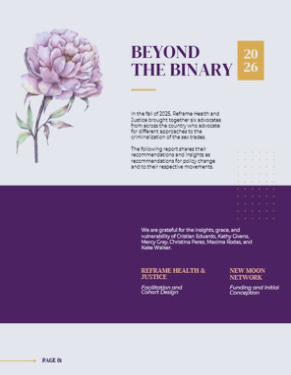
New Moon Network’s Common Cause Initiative and accompanying publication of recommendations, Beyond the Binary, demonstrates a high-impact model for overcoming this stagnation and gradually building alignment between movements with opposing viewpoints. By convening six advocates with divergent views on the sex trade but shared lived experience within it, the initiative successfully shifted the paradigm from conflict to collaboration. The result was a unified consensus on six priority policy recommendations grounded in a shared value: universal safety and nonjudgmental care. For funders and philanthropists, this case study offers a proven framework for confronting movement division, maximizing the return on investment in social justice, and fostering sustainable, community-led systems change.
The results from this pilot project are inspiring, but there is much more to be done. Beyond the Binary was created after just 6 brief sessions between advocates with opposing viewpoints. In this time of social division and intense conflict, New Moon is committed to fostering dialogue across differences. While we may hold different views and opinions about the sex trade and how to govern it, we all care about the safety and welfare of people within it. And for us, this is a starting point worth exploring more deeply.
The Challenge: Fragmentation within Feminism
For decades, the landscape of advocacy surrounding the sex trade has been defined by a rigid, false binary. Rooted in complex feminist history, the field has been split between two distinct camps: those advocating for the abolition of the sex trade and those fighting for its full decriminalization.
This ideological siloing has created significant systemic inefficiencies and harms:
Policy Gridlock: Legislative progress has been stalled as opposing factions cancel out each others’ efforts. Progress is made and undone in an ongoing cycle of pendulum swinging. Some lawmakers refuse to engage on the subject of the sex trade due to perceived “in fighting” among feminist organizations and advocates. .
Funder Confusion: Funders are likewise forced to “take a side” in their giving portfolios, choosing between organizations that both prioritize safety and autonomy but in drastically different ways. At times philanthropic capital has also been weaponized, forcing organizations to compete for resources based on ideology rather than impact. Organizations and advocates are fearful of being honest about their policy perspectives, for fear of losing funding.
Advocate Trauma: One of the worst consequences of the sex trade debate is the psychological and emotional toll it takes on advocates with lived experience in the sex trade. The false binary encourages these advocates to see each other as an enemy rather than a potential peer with similar experiences or different perspectives to increase collective knowledge. The division frequently pits survivors against survivors, and places unnecessary burden on individuals to “win” for their side.
Harm to Beneficiaries: The most severe consequence has been the failure to serve individuals in need. The “victim vs. worker” narrative has flattened complex human experiences, leaving many without access to essential care, safety, or community support.
This division is not merely theoretical; it has concrete, detrimental effects on policy and human welfare. The status quo has served external agendas while inflicting unnecessary trauma on those already marginalized by violence, stigma, and discrimination.
The Intervention: A Model for Generative Conflict
Recognizing that traditional advocacy methods had reached a point of diminishing returns, New Moon Network launched the Common Cause Initiative. The objective was not to erase differences, but to build a bridge across them through a structured, facilitated cohort learning process between individuals whose ideologies were unaligned, and in some cases, greatly opposing.
The Cohort Design
Participants: 6 advocates with lived experience in the sex trade, intentionally selected to represent both the “End Demand” and Decriminalization perspectives.
Methodology
Over six 90-minute sessions, the group engaged in a curriculum designed to prioritize relationship-building over debate. The process was facilitated by Reframe Health & Justice Consulting.
Core Principles
The process was grounded in “generative conflict”, a strategy that leverages deep disagreement as a catalyst for innovation rather than division. Before discussing the topic at hand (sex trade policy), participants established shared community agreements and engaged in collectively chosen learning topics to root conversations in shared humanity.
Key Findings: Consensus Through Shared Values
Despite entering the process with fundamentally different goals regarding the future of sex trade policy, the cohort achieved a consensus on core values and specific policy actions:
A Unifying Value Proposition:
The group identified a foundational principle transcending their ideological differences: Everyone, regardless of their experience in the sex trade, deserves safety, non-judgment, and care. This agreement validated every participant’s lived experience as legitimate, dismantling the hierarchies such as “deserving” vs. “undeserving” or “credible” vs. “not credible” that has long plagued the field.
Tangible Policy Outcomes:
Moving from values to action, the cohort collaborated to produce six specific policy recommendations. These priorities, spanning issues from immigration reform to service funding, represent a unified agenda that both sides of the movement can support. While some of these recommendations are explicitly about the sex trade, some address basic human needs essential for preventing exploitation or promoting healing, stability and well-being. This output demonstrates that when advocacy is centered on human dignity rather than ideological purity, actionable policy pathways emerge.
All people deserve access to a diverse set of non-judgmental and affirming services, regardless of their lived experience and self-identification, and without conditions of involvement in criminal-legal proceedings or abstinence from trading sex. Funding should seek to transparently support culturally responsive services to groups disproportionately impacted by exploitation, including communities of color and trans communities.
Robust, long-term, and ongoing quality healthcare should be free and accessible to all people, including those without documentation or irregular migration status.
We categorically opposed the expansion of criminalization for people who sell sex. We recommend that jurisdictions allocate and/or expand funding and resources for people looking to leave the sex trade, and for those looking to create safety under criminalization while trading sex.
Law enforcement should be banned from engaging in any sexual contact with a potential witness, victim, victim-offender, or perpetrator during investigations of a crime.
Access to affordable and free housing should be expanded for individuals with lived experience in the sex trades.
Prostitution and Solicitation should not be deportable offenses.
Implications for Philanthropy and Strategic Funding
For funders committed to human rights, social justice, and effective altruism, the Common Cause Initiative offers critical insights into maximizing impact:
Invest in Process, Not Just Projects. Sustainable change often requires funding the infrastructure of collaboration (facilitation, dialogue, and relationship-building) before expecting policy wins. The “soft” work of bridge-building yielded “hard” policy recommendations that may reduce pendulum swinging.
Support Lived Experience Leadership. The success of the initiative underscores that those most impacted by an issue are best positioned to identify solutions. Funding models that center lived experience leadership, even amidst disagreement, can unlock innovative solutions that external experts are unlikely to be able to replicate.
Resolve Fragmentation to Unlock Scale. Movement fragmentation is a major risk factor for philanthropic investment. By supporting intermediaries like New Moon Network that are dedicated to healing these rifts, funders can unblock gridlock and pave the way for scalable, unified advocacy efforts.
Embrace Generative Conflict. Avoiding conflict often leads to stagnation and the festering of resentments. Strategic philanthropy should support spaces where deep differences are engaged constructively, transforming potential fractures into sources of education, resilience, creativity and unity.
Conclusion: A Blueprint for Collective Liberation
The Common Cause Initiative proves that the divides which seem insurmountable are often artifacts of outdated (sometimes artificial) frameworks, not irreconcilable realities. By shifting the focus from “who is right” to “what do we all need,” the Common Cause cohort created a blueprint for advancing sensible policies.
As New Moon prepares to iterate on this model, the message to the philanthropic community is clear: Community-led dialogue rooted in care and intention is a transformative strategy. It is how division is interrupted, how deeper understanding is built, and how advocacy becomes aligned with the full spectrum of human experience. We all care about people with lived experience in the sex trade, and it’s time we start working together.
We invite funders to consider how their portfolios can support similar bridge-building initiatives such as this one. In this time of crisis and political divide, recognizing our shared humanity and identifying what we all agree on is essential The return on investment is not just in policy changes, but in the restoration of dignity, the healing of community wounds, and the creation of a more effective, unified movement for justice.